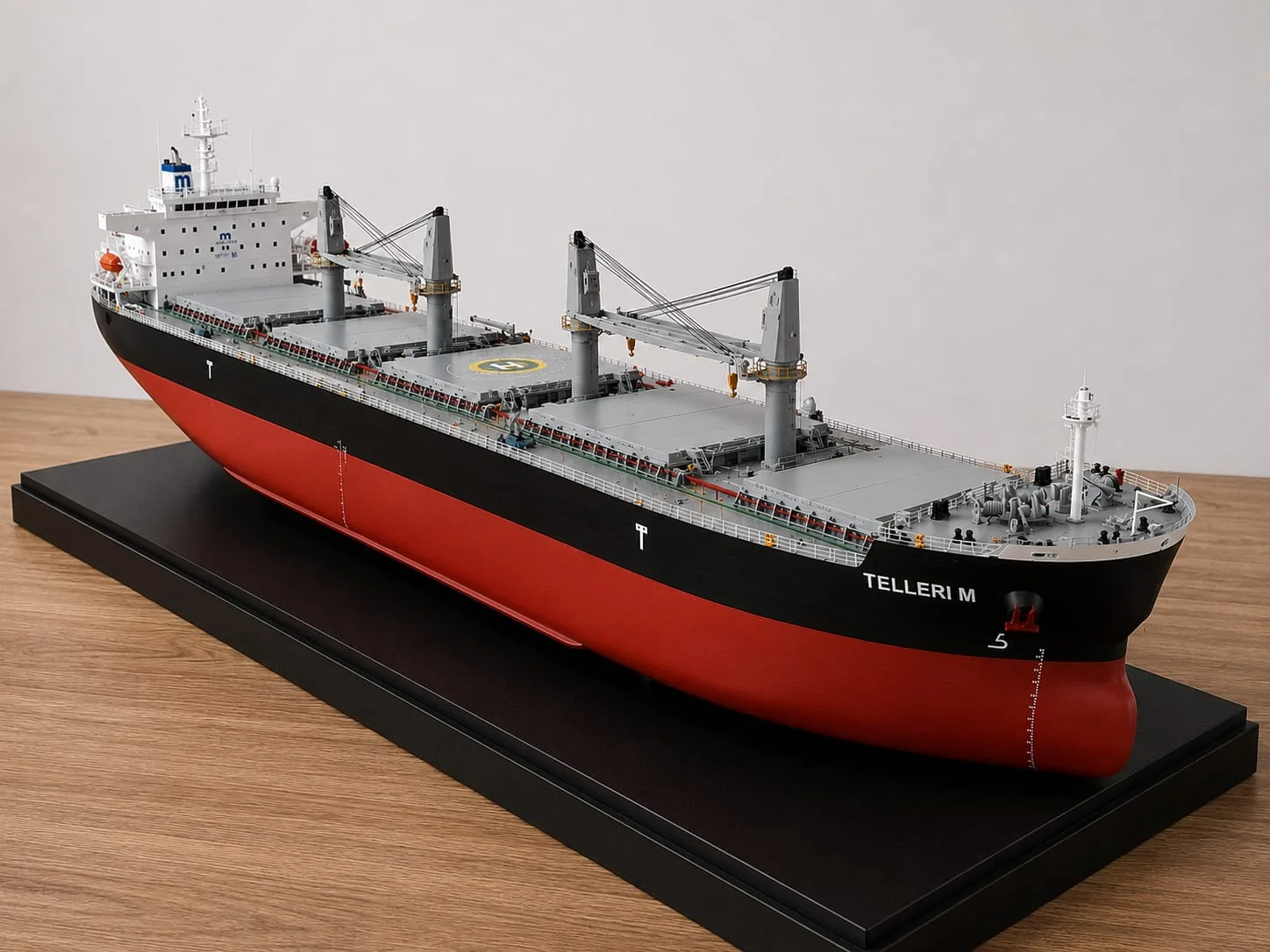
In shipbuilding, small proportional errors are never really small. A ship scale model built for a shipyard, naval institution, or design review has to reflect the actual vessel with genuine engineering accuracy, not just a general visual resemblance, because it is often used to evaluate real design decisions rather than simply decorate a room.
Where Accuracy Actually Matters Most
Hull form, superstructure placement, and the ratio between beam and length are the details naval architects check first when reviewing a build. Deck equipment layout, mast and antenna positioning, and lifeboat placement also matter for vessels being reviewed for operational or safety assessments, since these elements are directly tied to the vessel’s real-world function.
For commercial shipping clients, brand-specific details such as funnel markings, hull colour schemes, and company logos need to be reproduced precisely, since these models frequently end up representing the company itself in front of clients and partners.
The Design Data Behind a Good Build
Studios building an accurate model work from general arrangement drawings, lines plans, and sometimes 3D CAD files supplied directly by the shipyard’s design office. Where full technical drawings are unavailable — as is often the case with older or historic vessels — builders rely on photographic reference and published specifications, cross-checking multiple sources to resolve any inconsistencies before fabrication begins.
This upfront research phase is one of the most time-consuming parts of the process, but it is also what determines whether the finished ship scale model will satisfy a technically trained audience or simply look approximately right to a casual viewer.
Fabrication Methods Used Across the Industry
Hulls are generally shaped through CNC machining for consistent curvature, then hand-finished to remove tool marks before painting. Superstructures and smaller components are frequently produced through 3D printing, which allows fine details such as railings, ladders, and hatch covers to be reproduced at scale without excessive hand-fabrication time.
Some studios also offer motorised or radio-controlled versions for clients who want a functional demonstration piece rather than a static display, particularly for naval and defence-related presentations where showing a vessel’s manoeuvrability adds value to the pitch.
Applications Across the Maritime Sector
Shipyards use a ship scale model during client negotiations and design reviews, allowing stakeholders to physically inspect a proposed vessel before construction commitments are made. Naval and coast guard institutions commission models for training centres and public exhibitions, often requiring higher security around design specifications during the build process.
Corporate maritime clients — port operators, shipping lines, and offshore service companies — commonly display models in reception areas and boardrooms as a representation of their operational fleet and capability.
Selecting a Studio for a Technical Build
Because these projects demand engineering-level accuracy, it pays to work with a studio that has handled naval or commercial vessel builds before, rather than one whose experience is limited to purely decorative pieces. Ask to review dimensional accuracy on previous work, confirm how confidential design data is handled, and clarify finishing standards for any model intended for long-term public display.
Requesting a small sample section — a portion of hull plating or a single deck detail — before committing to the full build is a reasonable way to evaluate a new studio’s precision without risking the entire project budget upfront.
How Scale Choice Affects Detail and Cost
Larger scales allow far more detail per component but increase both material cost and build time significantly, while smaller scales are more affordable and portable but limit how much fine detailing — railings, hatches, individual portholes — can realistically be included. Matching scale to intended use, rather than defaulting to the largest option available, usually produces the best balance between cost and visual impact.
Shipyards presenting to technical review panels often prefer a mid-range scale that allows close inspection of hull form without the transport and storage challenges that come with an oversized build.
Working Around Confidential Vessel Designs
New vessel designs are often commercially sensitive, particularly during competitive tendering between shipyards. Studios experienced with this kind of work typically operate under signed confidentiality agreements as standard practice and restrict internal access to design files to a small dedicated team, which is worth confirming explicitly before sharing unreleased drawings.
Some clients also request that finished models be delivered directly to a secure location rather than displayed at the workshop itself, and an experienced studio should be able to accommodate this without difficulty.
Standing Up to Close Inspection
A well-executed build earns its place in front of engineers and clients alike, standing up to close inspection rather than only looking convincing from a distance.
Training and Simulation Uses
Beyond presentations and reviews, maritime training academies increasingly use detailed physical models to teach cadets basic vessel orientation, deck layout terminology, and safety equipment locations before those students ever board a real ship. A tactile, three-dimensional reference tends to build spatial understanding faster than photographs or video alone, particularly for trainees encountering ship layouts for the very first time.
Some training centres commission a family of models representing different vessel classes, allowing students to compare hull forms and deck arrangements side by side, which helps reinforce concepts that are otherwise difficult to convey through classroom instruction alone.
The Value of Consistency Across a Fleet
Shipping companies that commission models of multiple vessels in their fleet over time benefit from maintaining consistency in scale, base design, and display format across the collection. Working with the same studio for successive builds makes this far easier to achieve, since the team already understands the company’s preferred presentation style and can match new commissions to the existing fleet display without starting from scratch on design decisions each time.
Final Thoughts on Commissioning a Technical Build
A scale build made with genuine engineering discipline becomes a lasting asset rather than a short-lived showpiece, useful across design reviews, client meetings, and training sessions for years after delivery. Taking the time upfront to source accurate reference data and choose a studio with relevant maritime experience is what ultimately determines whether the finished piece earns that kind of long-term value.